EASTER ROSS BEEKEEPERS' ASSOCIATION

WEB SITE FOR APIARISTS

TAIN APIARY, SCOTSBURN ROAD, TAIN, ROSS-SHIRE, SCOTLAND


BLOG - LATEST NEWS
NEW YEAR MEETING Thursday 4 February 1020
This is the first meeting of 2010. Tea and biscuits and a chat about the new season. Come along to share your views and get some good advice.
SAD NEWS
Sadly on Tuesday 10 November we learned of the death of Willie Shaw. He'll be sorely missed and we were proud to know him.
SOCIAL EVENING Thursday 12 November
A note for your diaries. The annual social evening is now booked for Thursday 12 November at the Royal Hotel, Tain at 7:30pm. This is free to members of the ERBA and non members and friends are welcome for the small sum of £5. Our visiting guest speakers are Neil and Evelyn Spence of Highland Bee Supplies at Farr. Please come.
SBA LECTURE TOUR Tuesday 12 October
Clive de Bruyn gave a fascinating talk to beekeepers from around the Highlands, hosted by Nairn BKA. The subject was maintaining healthy bees. At least we now know from Clive that "life as we know it" is continuing! He gave us hope that if we look after bees they will thrive. Had he suffered from heavy losses and varroa? No! Tons of good tips and commonsense were liberally dispersed with anecdotes of personal experience. Here are a few quotes and tips:
Thank you Clive and Nairn BKA
END OF SEASON TALK Saturday 10 October
Graeme Sharpe, bee advisor - SAC, gave a free talk to beekeepers on:
Saturday, 10 October at the Scout Hall, Brora (opposite the library) from 7pm to 9pm.
The Talk is entitled "The Hive Doctor - Bee diseases and parasites identification, Control and Treatments".
For further information please contact Diana Royce on 01408 622094
***EFB found in Inverness***
European Foulbrood has been detected in Inverness. Members should carefully check their hives over the coming weeks. EFB is a reportable disease - see below on how to report. Full details can be found on the SBA website and how to recognise it. Follow the link:
www.scottishbeekeepers.org.uk/services/html/diseases.html
Then follow the link on the RHS for "SBA report on current EFB..."
CCD BRIEFING Saturday 25 July
On Saturday, 25 July, we were treated to a fascinating talk at the apiary from Jennifer Hill and her husband, Keith Brownell. They both work in North Carolina, USA, for Syngenta, (Novartis, Astra-Zeneca) the largest agribusiness in the world, in crop protection.
In the main they explained the issues concerning CCD (Colony Collapse Disorder), a little about the farming business in the USA and the current programmes here, in Europe, and in the USA, to improve habitat.
We know about the importance of bees for pollination but the statistics are frightening, in California alone the almond crop is serviced by 1.5 million colonies each year. The key factor causing CCD has still not been found, most likely a combination of factors, stress, varroa, IAPV (Israeli Acute Paralysis Virus), pesticides, genetic diversity of queens and drones and bee management.
We debated the influence of pesticides and GM crops. Undoubtedly, pesticides improperly applied (dosage and time of day) are harmful to bees and the effect of GM crops containing insecticidal proteins are being very carefully studied in the USA and Europe.
It was also interesting to hear of the contrast of the US landscape with that of Europe. The dominance of a mono culture form of agriculture in California, Nevada, Utah, Arizona, Florida and New Jersey and the reliance on pollinators in those states is far from the position of smaller mixed farms in a rich variety of habitat in Europe. The policy of the new US administration of President Obama is now to change from a subsidised farming economy to a environmentally sustainable one. This will not be easy when one considers the future demands of a growing and more affluent world being met by the USA's farmers.
Please check out the following links on some of Syngenta's projects, their work in the field of environmental management and the work of the US Department of Agriculture (USDA).
www.syngenta-crop.co.uk www.operationbumblebee.co.uk www.croplifefoundation.org www.ars.usda.gov (CCD)
Many thanks Jennifer and Keith for visiting our apiary and giving your time to talk to us.
CLOSER TO HOME
Still no further tangible progress from our Government on the matters below!
ON LINE DEBATE
As promised I have chased up the Rural Directorate for the latest news on the Government's progress (see below). As a result :-) there was a debate in Parliament on Wednesday 20 May from 5pm!
ASSOCIATION OFFICERS:
Membership: Approx 36 beekeepers with from 1-10 hives
Subscriptions from 1 April 2009 £4.50
The Co-operative Plan Bee
The Co-operative embarked on a major campaign in February to promote bee health following the disastrous collapse of the British honeybee population. Please follow the link to "Plan Bee" and engage in the support they are giving us.
www.co-operative.co-op/ethicsinaction/takeaction
The Scottish Government's Bee Health Strategy
"This working document aims to address the current challenges facing beekeepers and to provide a plan of action to sustain the health of honey bees and beekeeping in Scotland for the next decade." We have now submitted our comments to the Scottish Government and await their conclusions and action.
The draft report can be found at: www.scotland.gov.uk/topics/agriculture/animal-welfare/policies/policyinfo/bees
As yet (its only been 6 months!) we have heard nothing from the Department of Rural Affairs and the Environment about their Draft Bee Health Strategy. However, DEFRA (of the U.K. Government) have announced a £10 million initiative "to be invested to help to identify the main threats to bees and other insect pollinators..." I have contacted the Department and await a reply.
Varroa
Tom Tew completed his round of oxalic acid fumigation for those members who requested the service in January. Don't forget to pay your £5 to the Treasurer.
Activities
We had an excellent talk in Marchfrom John Mcmorran, following on from the talk by Hamish Robertson. Thank you John.
Last winter we saw the worst losses of bee colonies in living memory. A combination of a terrible summer, a long bleak winter together with the deadly effect of varroa caused the stocks of some beekeepers to be wiped out entirely.
What can we do? We need to rebuild stocks for next year. Next summer when colonies are stronger they should be split and weak colonies need to be joined with strong ones. Other should be artificially swarmed and queen cells collected and used to set up new neuks. Any feral swarms should be rescued. Beekeepers must unite and work together.
Please see below for the dates of the Association's summer programme, which are an opportunity for beekeepers to discuss their problems and needs for the new season and get advice. Members and non members are welcome and especially beginners, who might be thinking of taking up beekeeping.
We continue to lobby our Scottish, Westminster and European MP's in the hope that they will recognise the seriousness of the situation and find ways to support us.
VARROA
Varroa has been detected widely in our area and losses have been heavy this summer and last winter. Members must now expect that varroa is endemic and should follow all necessary procedures to check and control the mite.
If you fail to detect varroa when it is present then you will almost certainly lose your colonies. The Association has been giving varroa advice at the Apiary and there is good reference material on the SBA web site, the Moray Beekeepers web site and the bee unit of the CSL, see the links below.


Photos courtesy of John Whitelaw -Lensonscotland
On 26 July 2008 Ian Craig from the Scottish Beekeepers' Association gave northern beekeepers a talk on the lessons we need to learn from the experience of heavy losses. The top tips are:
On 4 December 2002 the New Opportunities Fund awarded the ERBA a grant of £3,000 under the Awards for All programme. This followed an application by the Association in September 2002. The Association has benefited greatly.

HONEY SHOW 2007 and 2008 and 2009
Unfortunately due to continuing poor seasons we have again decided not to hold the annual honey show normally scheduled in November. This is replaced by a social evening at the Royal Hotel, Tain with a visiting speaker on 12 November - see below.
WINTER PROGRAMME 2009/10
Thursday 4 February 2010 - 7:30pm Bee chat at the Duthac Centre. New beekeepers welcome
Thursday 4 March - 7:30pm at the Duthac Centre
Thursday 8 April - 7:30pm Visiting speaker on bee disease management at Duthac Centre with beekeepers from Dingwall and Sutherland
Thursday 29 April - 7:30pm Annual General Meeting at the Duthac Centre
EQUIPMENT ORDERS
Before buying any new equipment or consumables please contact Pip Whitelaw, Treasurer, on 01862 842088 who can probably organise supplies competitively. Locally, you can always contact Highland Bee Supplies at Farr on 01808 521311 and www.highlandbeesupplies.co.uk. Catalogues and price lists can be obtained from Thornes of Scotland by phoning them on 01337 842596 or on www.thorne.co.uk
SECOND HAND EQUIPMENT
New members are always asking for second hand equipment so if you have some spare which you want to get rid of please let us know so we can pass it on.
APIARY
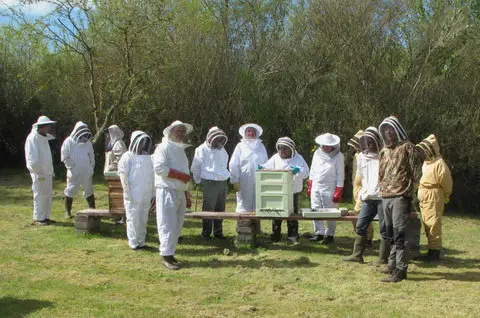
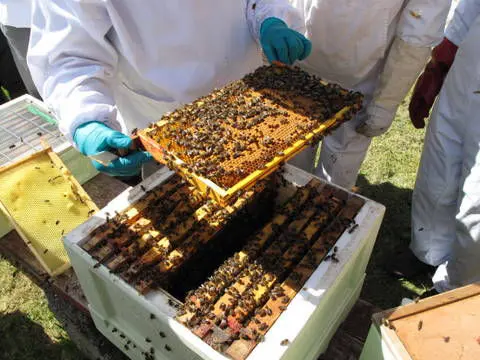
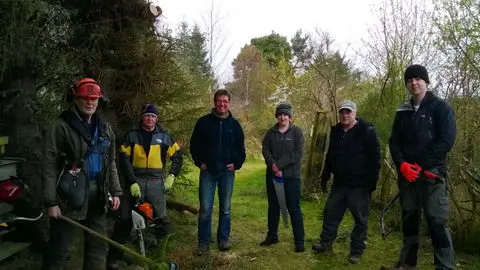
The apiary is now managed by rota. The Association's summer meetings are held there to enable members to contribute to the upkeep of the apiary and for beginners to gain hands-on experience from senior beekeepers. Members may also tend their own hives there with the permission of the Secretary.
The Association does not accept any responsibility or liability for any loss, damage or injury to members or visitors arising from their presence at the Apiary. Members and visitors are responsible for their own safety and they should ensure that they are suitably attired and are reminded that beekeeping has attendant risks of which they should be aware.
Apiary Map showing Scotsburn Road The Apiary is 500 yards along the Scotsburn Road on the left hand side at the Scottish Water Rosehill Reservoir. And if you want to check the weather before you go to the meeting go to:
www.metoffice.gov.uk/weather/uk/he/invergordon_forecast_weather.html
GUIDANCE ON SALE OF HONEY
Members who sell their own honey must consult and practise the guidance issued by the Scottish Beekeepers' Association. Failure to observe this may open them to prosecution or legal action from a consumer or from the Council Trading Standards officers.
The guidance covers the Food Safety Regulations, rules of hygiene, labelling, composition, weights and measures, hazards analysis etc.
Follow this link for an on line and printable guide www.scottishbeekeepers.org.uk
Please note from September 2003 a new EU Directive and UK legislation requires that the label also shows the "Best Before Date" and the producing country.
SWARMS
The Association offers a service to the public to collect swarms of honey bees from the local area particularly during the months of June and July. Any member of the public who is troubled by a swarm should contact Tom Tew on 01862 811310 who can make arrangements to remove the swarm safely. Because of the risks, skills and equipment required we normally make a charge of £20 per hour plus the cost of any consumables. This is considerably less than the charges from pest control firms and also ensures the survival of the colony of bees. The charges are negotiable and will take into consideration ability to pay.
The Association is also pleased to manage or relocate abandoned feral hives and is particularly interested in the native Scottish black bees. Please note that the Association will not accept any liability for loss, damage or injury which might arise from the handling and management of any third party bees by any member of this Association.
VARROA/EFB
Should you detect a varroa or EFB outbreak in your hives you should notify the SBA Northern Representative (see below) and Senior Agricultural Officer, Highland Area Office, Longman House, 28 Longman Road, Inverness IV1 1SF (Tel: 01463 234141). This ensures that the latest scientific and statistical information is held nationally.
Hive samples for testing to:
S.A.S.A. 1 Rodinglaw Road, Edinburgh, EH12 9FJ (packages marked "Bee diseases") Note the service is free.
Information on Varroa and other bee diseases please visit the Bee Unit site of Central Science Laboratories, Sand Hutton, Yorks. CSL is an executive agency of DEFRA. Web site: http://beebase.csl.gov.uk
For guidance to treat varroa we recommend the following web sources:
www.moraybeekeepers.co.uk/varroa.htm This is the Moray Beekeepers web site and their advice is clearly presented.
INSECTICIDE OR PESTICIDE DAMAGE
The spray liaison officer to whom all queries should be addressed regarding proposed spraying or spray damage to bee colonies is Mrs Prue Douglas Menzies (Tel: 01862 871572).
THE SCOTTISH BEEKEEPERS' ASSOCIATION
The ERBA is affiliated to the SBA
See the SBA Websiteon: www.scottishbeekeepers.org.uk
SBA Subscriptions from 1 January 2009 are £25 including magazine and insurance.
Our Northern Area representative is:
John Cartlidge, Badger's Walk, Culmill, Kiltarlity, Beauly, IV4 7HP Email: jbadgerswalk@aol.com
LINKS
To our local communities and local associations:
www.spanglefish.com/DingwallBeekeepers/
ORDERS FOR ERBA APIARY HONEY
Please order your honey from us by email to: riwylie@gmail.com
State the number of 10oz containers you require. The containers are a secure plastic mailable type. The price is £7.50 inc. post and packing (UK inland rate). Add your name and address and we will ship on receipt of your cheque made payable to Easter Ross Beekeepers' Association. Cheques to be sent to the Secretary, Little Gluich, Edderton, Tain, Ross-shire, IV19 1LQ. Please allow 10 days for the completion of the transaction.
Last revised: February 1, 2010
Webmaster Robert Wylie